Instagram Transcript / Field guide 02
Check an Instagram transcript before quoting it
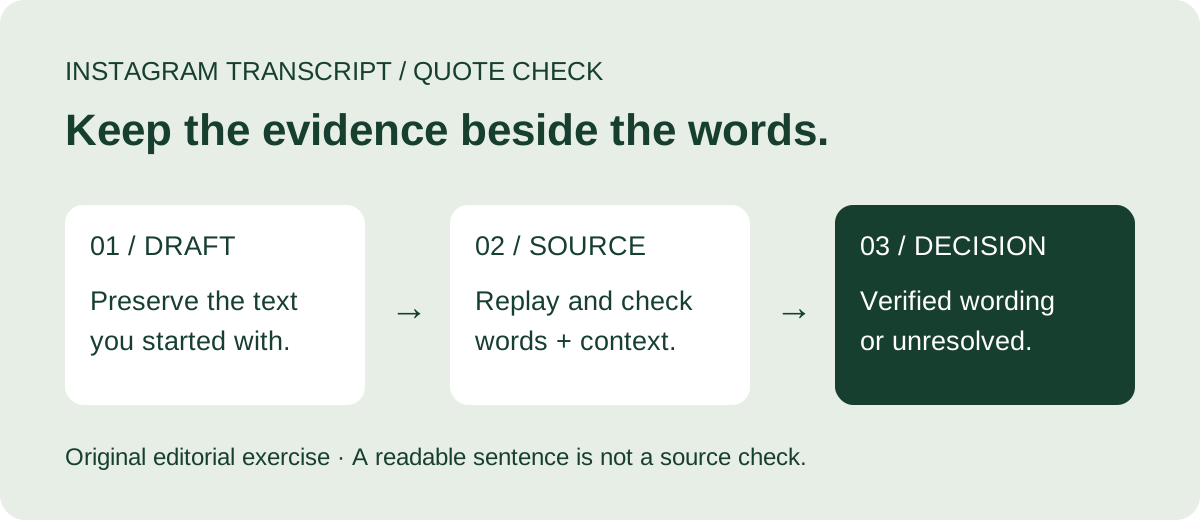
Before quoting an Instagram transcript, replay the original audio and check the exact passage, including the sentence around it. Verify numbers, units and words such as “not.” Keep the draft, the checked wording and a time reference together. If you cannot hear a word clearly, mark it as uncertain and leave it out of the quotation until you can verify it.
Download the quote-check worksheet
Keep a small evidence record
Use one worksheet row for each passage you intend to reuse. Record a source reference you can reopen, the passage time, the untouched draft, your checked wording and the check status. A readable transcript is useful for finding a passage; replaying the source is the step that lets you verify what was spoken. Do not change an uncertain draft into a confident quotation simply because the sentence sounds plausible.
The downloadable CSV contains three practice rows and one blank row. Replace the practice material with your own source references. Its statuses describe an editorial decision, not a confidence score from a transcription model.
Exercise 1: a number needs its unit
The reference sentence we wrote for this exercise is: “Use fifteen milliliters, not fifty.” The deliberately altered draft reads: “Use fifty milliliters, not fifteen.” Both sentences look grammatical. Their instructions are different. In the worksheet, the draft stays in its own column and the reference sentence goes in the checked-wording column. The issue field says “quantity reversed,” so a later reader can see why the correction mattered.
The time reference is EX-01, an exercise identifier, rather than an invented timestamp. In a real recording, replace it with the interval where you actually heard the sentence. Keep “milliliters” with the number. A bare correction from fifty to fifteen would lose the unit needed to interpret the instruction. These are authored strings, not output from a speech-recognition run.
Exercise 2: keep the negation
Our second reference sentence is: “Do not publish the draft before Friday.” The altered draft is: “Publish the draft before Friday.” The worksheet marks the issue as “missing negation” and restores the full reference wording. Removing two short words reverses the instruction; polishing punctuation would not repair it.
For this exercise, the status is “checked against authored reference.” For your own recording, use “audio checked” only after listening. If the beginning of the sentence is clipped, keep the row unresolved. Do not infer a missing “do not” from what you think the speaker probably meant. Check enough of the surrounding passage to establish whether the sentence is an instruction, a correction or a quoted example.
Exercise 3: leave an uncertain name unresolved
The third practice draft is: “Send it to Mara.” We have deliberately supplied no reference sentence for the name. The checked-wording cell therefore stays empty, the issue says “name not verified,” and the status is “unresolved — exclude from quote.” This row demonstrates a useful stopping point: a worksheet can preserve uncertainty instead of hiding it.
Changing Mara to Maria, adding a surname or attaching an identity would invent evidence. In a real source, replay the passage and look for an explicit identification supplied with that source. If the spelling remains unknown, keep the private working note unresolved or choose a different, independently checkable passage. An empty verification cell is preferable to a fabricated correction.
Read the worksheet as a decision trail
Across these three rows, two examples have authored references and one has none. The two corrected rows must keep both versions: replacing the draft would erase the visible reason for the change. The unresolved row must keep an empty checked-wording field. Our local CSV check confirms these conditions and four data rows, including the blank template. It does not test transcription accuracy or prove that any real recording was reviewed.
When you adapt the file, use a separate row for a separate claim. If one sentence contains a verified number and an uncertain name, do not mark the entire sentence verified. Split the passage or retain an unresolved status until every part you plan to quote has supporting evidence.
Use the checked text without changing its meaning
Keep a direct quotation separate from a summary or translation. If you rewrite the wording for a caption or explain it in another language, label that new text appropriately rather than presenting it as the original spoken sentence. Retain the source passage so you can revisit the comparison.
For a local video in TranscriptLeaf, choose Original output when your purpose is to check the spoken wording. The tool currently accepts saved files rather than Instagram URLs. Keep your source file available for replay while you review the text. A corrected quote also needs checking in any separately edited subtitle export. For subtitle file structure, use the Instagram transcript to SRT worked example.
Choose what is ready to use
Pick the passage whose wording and context you can support, copy its checked version, and retain the worksheet alongside your source reference. Leave an unresolved passage in the working file rather than carrying its uncertain words into a public quotation. Your final record should make it possible to answer one concrete question later: which source passage supports these exact words?
How this guide was made
The reference sentences, altered drafts, CSV and diagram were written for this page. No example is a quotation from an Instagram creator. The exercise checks editorial recordkeeping, not model accuracy. The workflow was developed after reviewing the linked transcription pages on November 1, 2026; their general copy-and-export workflows do not establish the accuracy of an individual quote.
GetTheScript: Instagram transcript · SpeakApp: Instagram transcription · WayinVideo: Instagram transcript