Instagram Transcript / Translation
Give translated Instagram subtitles time to be read
If translated subtitles disappear too quickly, compare the wording with each cue’s duration. Shorten carefully or retime in an editor, then check against the video.
Download the reading worksheet
Start with the interval, not the file extension
An Instagram transcript can be readable as a document while its subtitle version is difficult to follow on screen. A timestamped export supplies intervals, not a guarantee that the wording fits them. Translation may change the amount of text without adding any display time. Watch the exported subtitle track with its destination video before treating it as finished.
Use the worksheet below to compare two versions of the same cue. Count visible characters, including spaces and punctuation, and divide by the display duration in seconds. The result is a comparison aid for your revisions. This guide sets no universal characters-per-second limit: reading needs depend on language, audience, layout and the surrounding video.
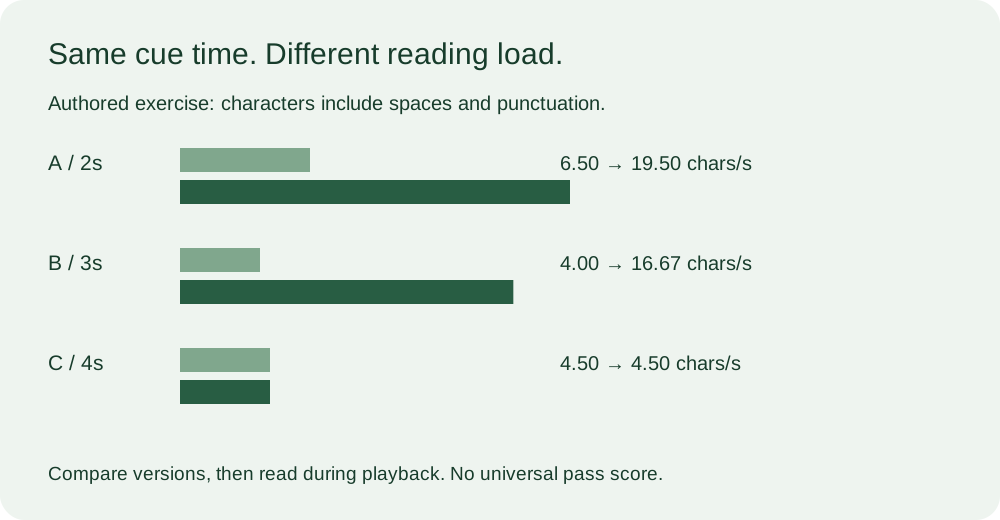
Exercise A: two seconds do not grow with the sentence
We authored both versions of cue A; neither is a quotation, a machine translation or output from a recording. The short version is “Open the box.” The expanded version is “Carefully open the small cardboard box.” Both use the same two-second interval. Their lengths are 13 and 39 characters, counting spaces and the final full stop. Dividing by two produces 6.5 and 19.5 characters per second. Those are arithmetic results, not measured reading speeds.
The expansion therefore asks the viewer to process three times as many characters in the same time. Our practice correction returns to “Open the box.” That is only safe within this exercise, where we defined the extra adjectives as optional. In real translation, do not delete a material instruction simply to make the number smaller. If “small” distinguishes the correct box from another one, preserve that distinction and consider changing the cue boundaries instead.
Try extending the interval from two to three seconds in a private copy of the worksheet. The expanded line becomes 13 characters per second. This improves the arithmetic but does not prove the edit is usable: the next shot or spoken sentence might begin before the extra second ends. No source video is supplied with this constructed exercise, so it cannot authorize an actual retiming decision.
Exercise B: do not hide a meaning change behind a better score
Cue B lasts three seconds. The short sentence is “Keep it dry.” Its 12 characters give four characters per second. The expanded sentence is “Store the paper away from water and damp surfaces.” Its 50 characters give about 16.67 characters per second. Our generated CSV retains both strings so you can repeat the counts rather than trusting a screenshot of a score.
This pair exposes a separate editorial question. “Keep it dry” does not specify a material, while the expansion introduces paper. These are deliberately authored alternatives, not equivalent translations certified against a source. A reviewer must first decide what the source actually says. A shorter line that names the wrong object is not repaired by having a lower character rate. Mark the wording unresolved if you lack the recording or context needed to decide.
For a reproducible check, add an exclamation mark to the short version. Its length rises from 12 to 13, and its three-second rate becomes approximately 4.33. The cue duration has not changed. This small edit demonstrates why the worksheet counts punctuation consistently and why comparisons must use the actual exported wording, not an earlier draft left in another tab.
Exercise C: a control row prevents the wrong diagnosis
Cue C uses “Use the blue side.” in both columns and lasts four seconds. Each version contains 18 characters, so both rates are 4.5 characters per second. The unchanged pair is our control row. If your own calculation gives different rates for those two cells, check the text and duration before diagnosing a translation problem.
An unchanged rate does not establish comfortable subtitles. A line can still arrive late, overlap a scene change, be hidden by interface controls or wrap awkwardly. Conversely, a rate increase alone does not prove failure. Replaying a cue at normal speed is necessary to judge the actual result. The control separates a text-length change from those other viewing problems without pretending to test any of them.
Apply the comparison to an actual export
Keep the source-language and translated exports separate. Match corresponding cues and record the duration, exact wording and a brief decision: keep, shorten after checking meaning, or inspect timing in an editor. If your tool splits or merges cues, match the relevant passage rather than assuming cue numbers still identify the same words.
TranscriptLeaf currently keeps the original cue times in translated subtitles. Its Text and SRT views also keep edits separately. Make a subtitle correction in the subtitle version you intend to download, then reopen that file in the destination editor. The SRT worked example covers cue structure; the quote-check guide addresses disputed wording.
For sharing a captioned clip, inspect the final rendered video as well as the separate subtitle track. Conversion or compression is a separate production task; it cannot decide which wording belongs in a translation. A cover graphic can label the language or edition, but it cannot fix subtitles that viewers cannot follow.
What was checked, and what was not
The worksheet and diagram were created for this guide. We counted the three authored pairs with a local script and checked the CSV values against those counts. There is no audio sample, real translation benchmark, audience reading study or vendor accuracy comparison here. The three rows demonstrate a revision method, not a pass certificate.
On November 2, 2026 we reviewed the Instagram tools from SpeakApp, Eden and GetTheScript. They describe link-based transcription and related output uses; the reviewed pages did not include this three-row character-budget exercise. That observation is limited to those pages.
Choose one troublesome subtitle, keep its two versions, and write down why you changed it. After replaying the result, retain the wording and timing that communicate the source clearly together. A useful revision has a reason you can explain, rather than merely a smaller number.